 Italiano
One consistent set of data.
Systems work on shared, consistent information. When new data is produced, it is automatically made available to the other systems — no manual re-entry, no diverging copies, no silent mismatches between tools.
Manufacturing landscapes grow as a patchwork of independent, legacy applications. An integration platform ties them together — so data stays consistent across systems and every process is driven through one logical interface.
One interface. Consistent data. Faster, higher-quality production.
Talk to our integration teamDo your systems hold the same data in different, inconsistent places?
Must operators jump between several applications to complete a single process?
Is information re-typed by hand between legacy systems?
Are new applications hard to plug into your existing IT landscape?
Do manual hand-offs slow production down and introduce errors?
Is process knowledge locked inside individual tools instead of shared?
Introducing an integration platform on top of independent systems delivers value on two levels — the data that flows between systems, and the processes that people and applications run every day.
Systems work on shared, consistent information. When new data is produced, it is automatically made available to the other systems — no manual re-entry, no diverging copies, no silent mismatches between tools.
The platform exposes one coherent interface to the different services and applications that implement a process. Each system talks to the platform instead of to a tangle of point-to-point connections.
The single process interface is not only for system-to-system integration. It lets us build a graphical application that leads the operator through the steps of a process in an intuitive, controlled way — reducing time and improving production quality.
Each interface is tailored to the specific needs of the system and its architectural constraints, whether it runs as a browser-based intranet site or as a cross-platform desktop application.
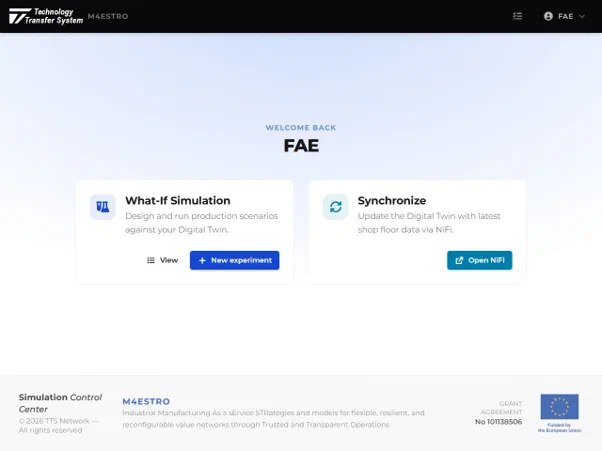
At the core sits a service layer that gives every system a common interface; around it, optional adapters bridge existing software, and a tailored UI brings the process to the people who run it.
REST web services — written in Java with Quarkus or Spring — provide a common interface to the organisation's different systems, while MQTT and WebSocket channels carry real-time messaging and live updates. The same layer feeds modern web front ends built with HTMX or React.
Where integration with existing systems requires it, an extra compatibility layer is built with custom applications in Java, C++ or C#, running on the major operating systems.
The UI is customised per solution: browser-based intranet sites, or cross-platform applications developed in Java/JavaFX for Windows, macOS and Linux.
TTS combines manufacturing engineering with solid software craftsmanship. We design integration platforms around the systems you already run — connecting applications, machines and data into coherent workflows, and shaping the interfaces that make those workflows faster and more reliable on the shop floor.
Tell us about the applications, machines and data you need to connect. We'll help you design an integration platform that fits your existing landscape.
Talk to our integration teamCookie Consent
This website uses cookies or similar technologies in an anonymized way. Analytics cookies allow us to count visits and traffic sources, so we can measure and improve the performance of our site. By continuing to use our website, you agree to our Privacy Policy.
TTS Assistant
Ask me about products and solutions